
More electricity yield, more Competition: BWO welcomes new land-use planning
Berlin, October 8, 2026. The Federal Maritime and Hydrographic Agency (BSH) has published the 2nd amendment to the area development plan.The Federal Offshore Wind Energy Plan (FEP) 2025 has been published. The German Offshore Wind Energy Association (BWO) welcomes the new spatial planning. The association particularly appreciates the lower power densities in area N-10, the division of large areas, and the stronger focus on actual electricity yield. At the same time, the BWO calls for the tender design to be structured in a way that strengthens competition and a diversity of participants.
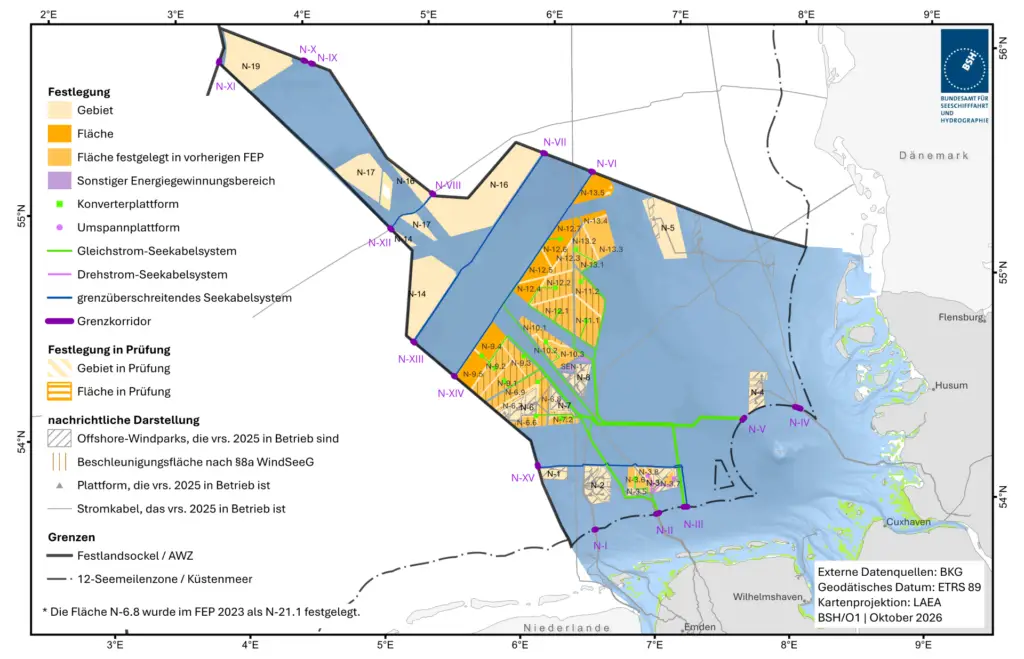
With the second amendment to the 2025 area development plan, the BSH (Federal Maritime and Hydrographic Agency) is adapting the area planning for the German North Sea and placing greater emphasis on actual electricity yield. Key changes include adjusted power densities, new and modified area boundaries, and a reorganization of the timeline for individual areas.
To achieve this, power densities in area N-10 will be reduced, and a previously planned 2 GW area will be divided into two smaller areas. In addition, the area will be increased from 195 km² to 259 km².
Designation Area | Land area [km²] | Estimated installed capacity [MW] |
N-10.1 | New: 87 km² Previously: 151 km² | New: 1.000 MW Previously: 2.000 MW |
N-10.2 | New 45 km² Previously: 31 km² | 500 MW |
New: N-10.3 | 92 km² | 1.000 MW |
This brings the plan closer to the BWO's demand to limit power density to a maximum of 8 MW/km². Lower power densities can reduce shadowing effects and thus improve electricity yield.
“The new plan places a stronger focus on electricity yield. Less shading and smaller area sizes improve the conditions for economically viable and feasible offshore wind projects,” says BWO Managing Director Stefan Thimm.
Tenders 2027: BWO demands a maximum of one award per bidder
The BWO views it positively that the new area layouts allow for smaller lot sizes. Areas with a capacity of around 1 GW can strengthen competition and facilitate the participation of different stakeholders in the tenders.
A total of four gigawatts are planned for 2027 across five sites:
- N-10.1 with 1 GW
- N-10.2 with 0,5 GW
- N-10.3 with 1 GW
- N-13.1 with 0,5 GW
- N-13.2 with 1 GW
“Areas of around 1 GW strengthen competition and a diversity of stakeholders. Therefore, the tender design should additionally stipulate that a bidder can only be awarded one contract per tender round. This limits concentration risks and distributes the implementation among several stakeholders,” said Thimm.
Spatial planning and tender design must work together
From the BWO's perspective, spatial planning must now be linked to a tendering design that enables investment and actually brings projects to fruition. The current amendment to the Offshore Wind Energy Act should therefore include a CfD-only model. Furthermore, the BWO calls for a binding indexation of the award values agreed upon in the CfD to the development of relevant costs. This reduces financing risks and increases the likelihood of project realization.
Background to the area development plan
The area development plan defines where and to what extent offshore wind farms can be built in the German North and Baltic Seas. Among other things, it determines the areas for wind turbines, their tendering and grid connection sequence, and the planned capacity. Furthermore, the plan contains specifications for power lines and grid connections.
About the BWO
The Federal Association for Offshore Wind Energy (BWO) is the political lobby for the offshore wind industry in Germany. We pool the technical expertise of companies along the entire value chain, from manufacturers to developers and operators to offshore wind energy service providers. For politicians and authorities at federal and state level, the BWO is the central contact for all questions relating to offshore wind energy.